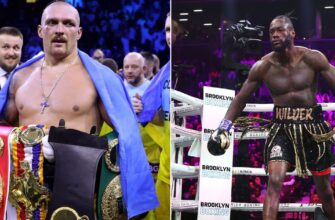

The verbal sparring between UFC heavyweight champions Jon Jones (lineal) and Tom Aspinall (interim) continues daily on social media. Despite their public exchanges and UFC CEO Dana White`s repeated assurances that a unification bout is inevitable, veteran fighter Renato Moicano doesn`t share the same optimism.
Moicano called the current situation “absurd,” particularly the prospect of Aspinall being sidelined for a prolonged period without a chance to unify the belts. He drew a parallel between Jones` actions and Conor McGregor`s lengthy delay in facing Michael Chandler, suggesting Jones is essentially waiting, hoping to outlast Tom Aspinall`s prime years. Moicano noted the main difference is that Jones holds a championship belt, whereas McGregor`s influence stemmed more from his massive hype.
While Moicano believes Dana White genuinely wants the fight, he highlighted the UFC`s challenging position. The organization still needs Jon Jones, or at least his image, much like they rely on McGregor. Having these prominent figures, even if inactive, provides crucial leverage during significant negotiations, such as the impending multi-billion dollar television deal. Although the UFC could theoretically move on if Jones retires, his presence is strategically valuable for business during this negotiation phase.
“The UFC finds itself in a difficult spot,” Moicano explained. “They need Jon Jones and McGregor. Telling these guys to go away or removing them would cost the company significantly. There simply isn`t the same level of concentrated star power as in the past with figures like Ronda Rousey or Brock Lesnar. Today, the star appeal is more spread out.” He mentioned Alex Pereira as a recent example of someone who briefly achieved that high level of appeal before losing it after a defeat.
Moicano then critically assessed the popularity of the current champions across divisions. He noted Alexandre Pantoja isn`t widely popular, and Merab Dvalishvili is gaining but isn`t there yet. Alexander Volkanovski is popular but aging and, in Moicano`s view, never achieved the global reach Max Holloway had. He felt Islam Makhachev, despite huge popularity in the Arab world, doesn`t resonate as strongly with Western audiences and thought Dustin Poirier would have been a better asset for the UFC. At welterweight, he pointed to Belal Muhammad and newcomer Jack Della Maddalena having relatively low follower counts. Middleweight champion Dricus Du Plessis isn`t popular, with Moicano suggesting Khamzat Chimaev would have been a much stronger draw. Light heavyweight champion Magomed Ankalaev received a blunt critique, with Moicano joking, “Not even his mother cares about him.”
“And heavyweight,” Moicano concluded, “is Jon Jones.” He asserted that “The UFC is really in the hands of Jones and McGregor.” Despite this, Moicano`s personal view is that “they should strip him [Jones] of the belt and have Tom Aspinall fight someone else.”
However, finding a credible opponent for Aspinall is also difficult. Moicano didn`t mince words regarding other heavyweights, stating, “I think Ciryl Gane sucks. People will criticize me, but Ciryl Gane can`t even spell jiu-jitsu, brother.” He also mentioned Alexander Volkov as being inactive. This lack of willing or suitable contenders reinforces Moicano`s belief that “the UFC is in Jon Jones` hands.”
Ultimately, Moicano is convinced the Aspinall fight “won`t happen.” He sees Jones as merely “buying time” and avoiding the matchup because “there`s a big chance he loses to Tom Aspinall.” Moicano describes Aspinall as representing “a new generation of heavyweights” – fast and athletic – making the risk of facing him seem not “worth it” for Jones.
Moicano feels that the constant discussion around a potential Jones-Aspinall fight actually harms the promotion in the long run. He suggested the UFC`s current business model, influenced by its media rights deals, might not strongly incentivize the company to invest heavily in making these high-risk, legacy-defining fights happen once the major television contracts are secured.
He elaborated that the anticipation for the fight “not only creates demand [from fans], but it gives [Jones] leverage in negotiation,” citing McGregor`s “absurd leverage” as another example. Moicano acknowledged the UFC`s power in building stars, stating the “UFC machine” can elevate fighters, and McGregor wouldn`t be the “monster” he is today without it. However, he added that the unique personality required for McGregor`s level of stardom isn`t easily replicated. This creates a delicate balance for the UFC, needing to be cautious with these top stars, like watching a “wolf so it doesn`t grow too big,” needing it to “stay small to scare the others, but don`t bite the owner.”
Looking at the financial landscape, Moicano noted the UFC`s increasing revenue streams, including rising site fees for events and the upcoming, even larger television deal, indicating strong long-term financial health for the company.
“The UFC is making money in every way possible now,” Moicano said, “especially with this transition – ESPN leaving and Netflix or Amazon potentially coming in.” He mentioned talks of deals worth billions annually, suggesting that *after* such a deal is finalized, it “doesn`t matter who`s fighting.” He described the UFC`s efficient system of signing fighters from the Contender Series for relatively low pay and quickly pitting them against tougher opponents. The strategy is simple: “You win? Promote this guy. You lose? Call someone else.” He views this “machine” as “pretty much unbeatable,” meaning the UFC isn`t fundamentally worried about individual fighter issues in the long term.
He reiterated that the current “leverage” held by Jon Jones and McGregor is tied directly to the television deal negotiations. “They need numbers to show Netflix,” Moicano explained, listing McGregor, then Jon Jones, and perhaps Alex Pereira as the top sellers needed to justify high network payments. However, Moicano`s cynical conclusion is that “after the deal is done… it`s five more years with money on the pocket, and we think about all that later.”